Start from the follow-up decision
A compliance reviewer does not only need to find a document. They need to know whether the required set is complete, whether anything has expired and what follow-up is required. I built the reference implementation around that decision.
Index the fields needed for review
The Azure AI Search index carries customer ID, customer name, document type, document number, expiry, status and content. Synthetic Emirates ID, passport, trade-license and proof-of-address records make the workflow testable without exposing real customer data.
Add explicit expiry and missing-document checks
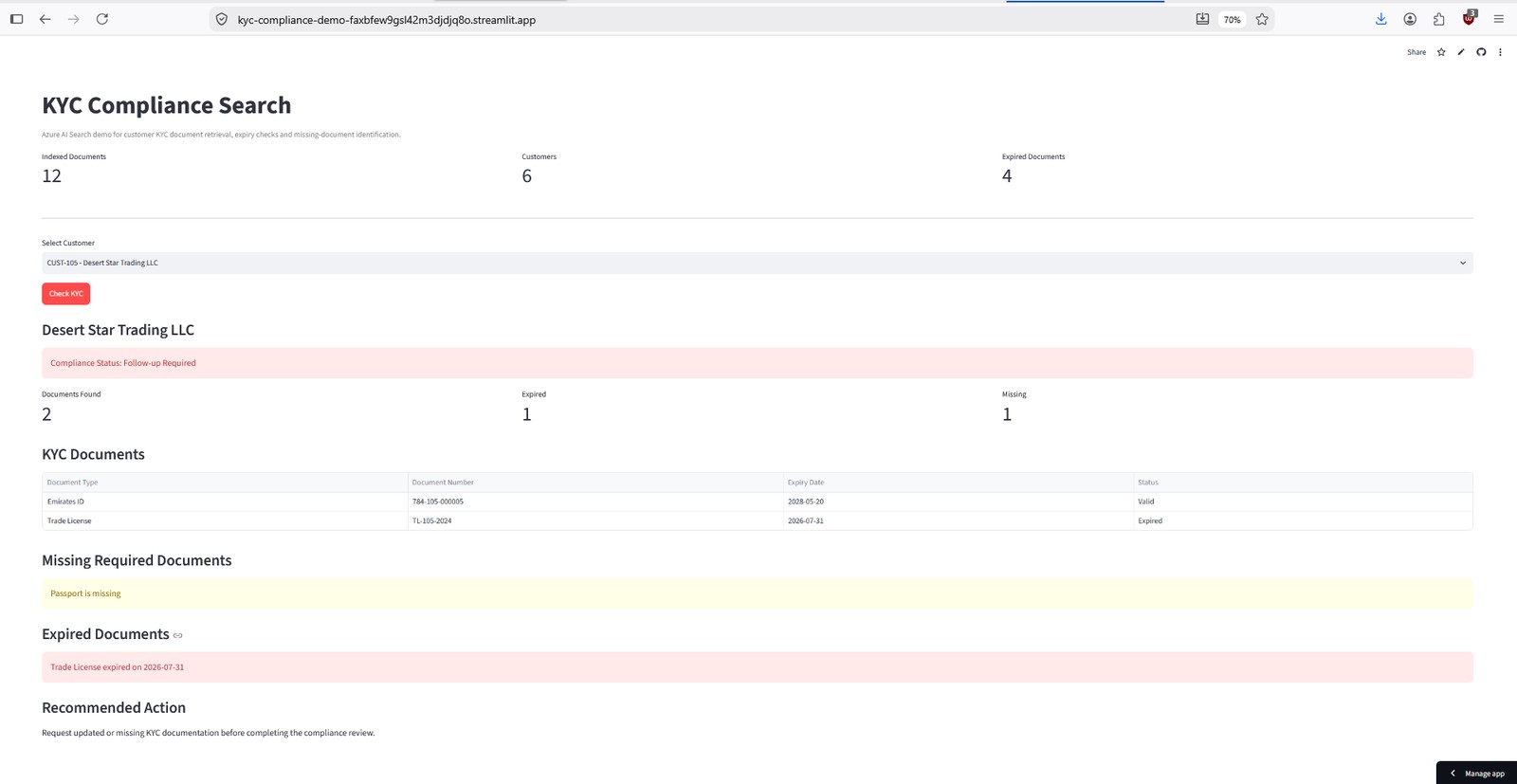
Search alone does not determine compliance completeness, so the application also checks expected document types and expiry state. The interface presents a compliance status together with a recommended next action.
Use a realistic incomplete profile
One sample profile contains a valid Emirates ID, an expired trade licence and a missing passport. That is more useful for testing than a perfect record because it exercises the follow-up logic the user actually cares about.
What this reinforced
- Search and business rules solve different parts of the workflow.
- Metadata must support both retrieval and compliance checks.
- Recommended action makes the result operational.
- Synthetic data is enough to validate workflow design before using sensitive information.
Related work
The same approach applies to other document-heavy workflows where the user needs both retrieval and a clear status / next action rather than search results alone.
See selected projects →